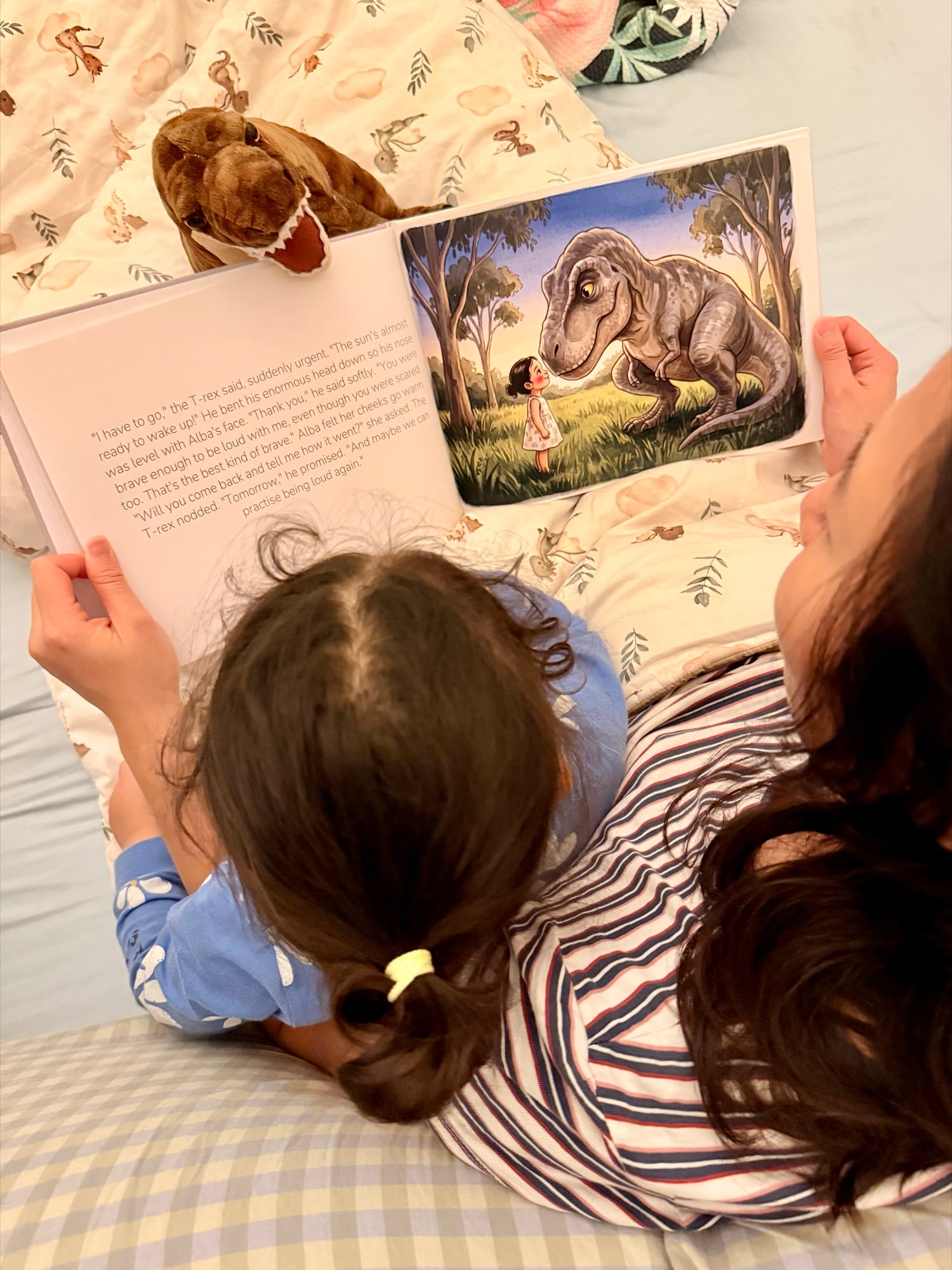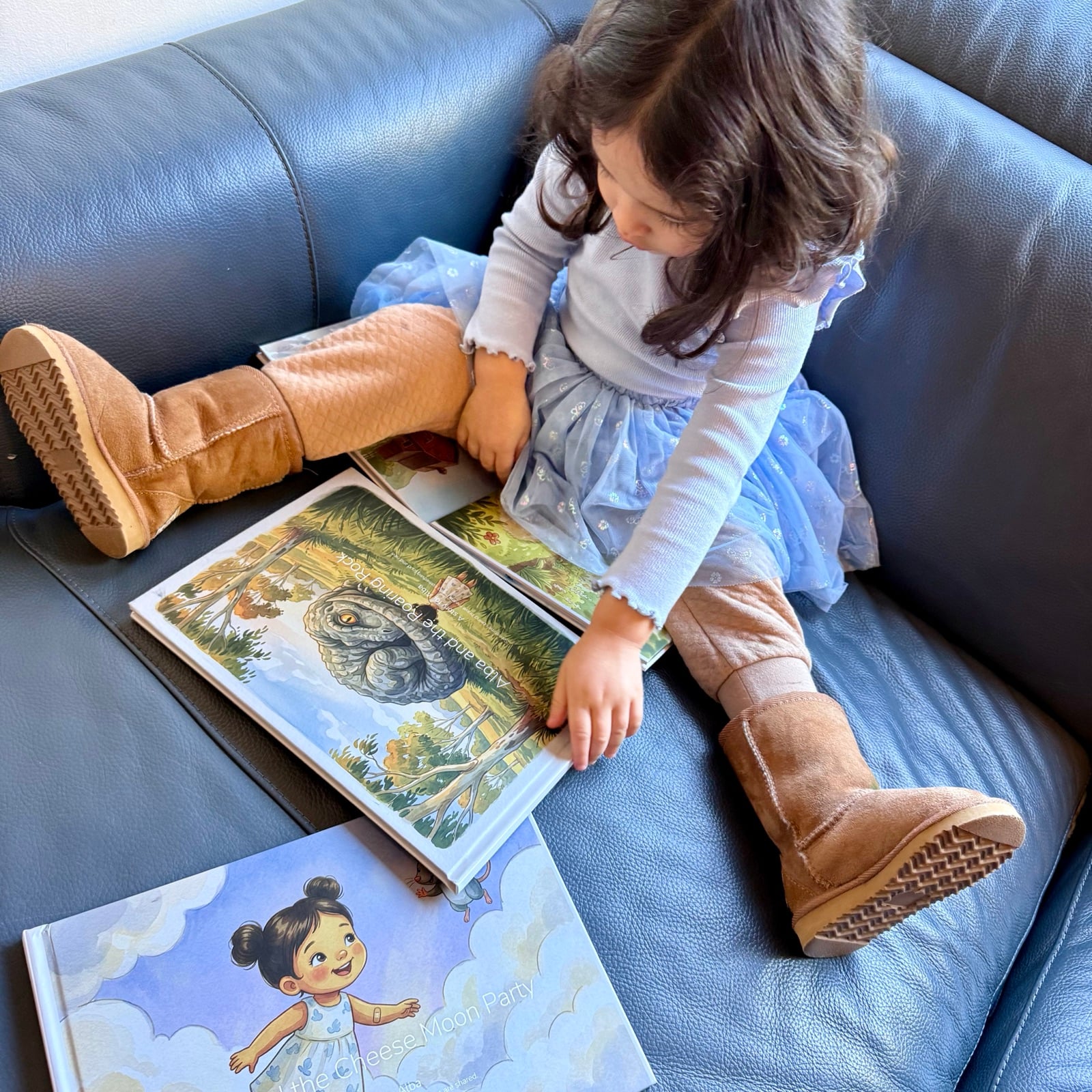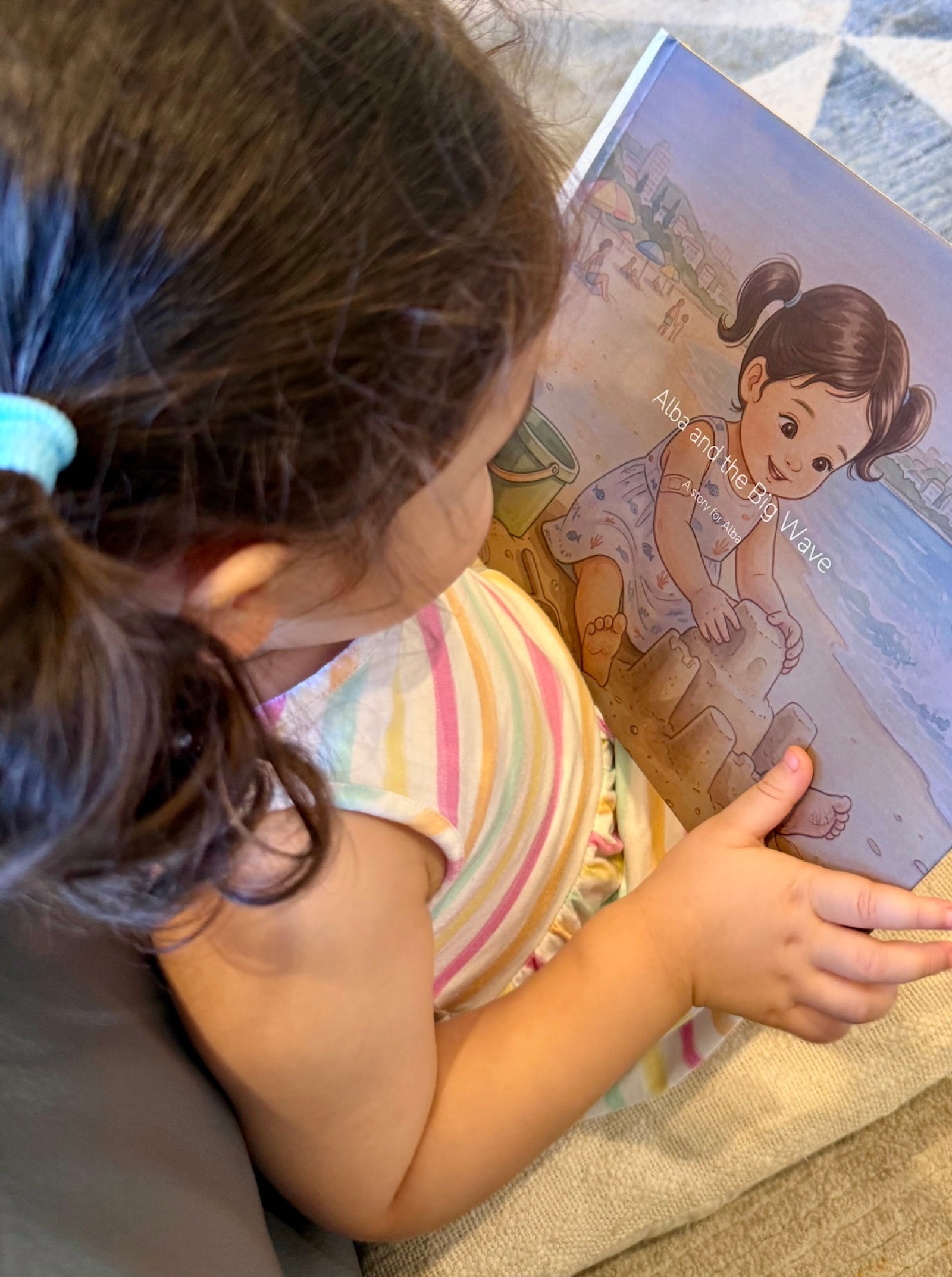
A few weeks back, our daughter, who is two, hit a "mine" phase at home. She'd pick a favourite toy, hold it tight, and when another kid wanted a turn she'd plant her feet and say "mine". We could have kept telling her sharing is caring. We could have practised it at home with random toys. Both reasonable. Neither worked.
What did work, in the end, was a hardcover Ellen made about mice on the moon throwing a party. The moon was made of cheese; the mice needed more for the party; and our daughter, illustrated as the kid in the story, went to collect some. She loves cheese, and once she had a stash she didn't want to share it. The mice's faces fell. Reading the book, she imitated the mice back: the slumped shoulders, the small sad face. And there, on the page, the lesson clicked. When she didn't share, the people around her didn't feel as happy as when she did. The book ends with her sharing what she'd gathered, the party landing, and everyone happy. That lesson has clicked through the book in a way no amount of us telling her "sharing is caring" had been able to do, because she didn't just hear the lesson. She stepped into the story as the main character and felt it from the inside, physically and emotionally.
We've thought about why a lot, because it sounds suspicious that a picture book outperforms the parent. This piece is what we landed on: a guide to teaching a toddler a lesson through a book, what to look for, and what to ask for if you're ordering a personalised one.
The short answer
A children's book can teach a toddler a lesson in a way a lecture often can't, because the lesson lands inside a story the child wants to come back to. The parent telling the lesson directly often competes with everything else the toddler is feeling in the moment (frustration, possessiveness, tiredness). The book offers the same lesson at bedtime, low-stakes, while the child is calm, in the form of a character they're rooting for. The lesson lands once. Then it lands again on the second read, the tenth, the fortieth. Repetition is a big part of how lessons stick at this age, and books are one of the most repeatable formats a parent can rely on.
Personalised books amplify the effect because the child sees themselves as the character on the page, which makes the lesson feel like it's about them, not about somebody else's kid.
Why lectures bounce and stories stick
Three things developmental research is consistent on1, and most parents notice anyway.
Toddlers can't follow abstract reasoning. A two-year-old usually can't hold "sharing is good because other people have feelings too" as an idea. The chain of causes is too long. What they can hold is "the mice were sad because no one shared the cheese, and then everyone shared and the party kept going". A story compresses an abstract lesson into a concrete sequence the child can follow.
Lessons taught in the heat of the moment land badly. When a child is mid-meltdown over a toy, they're often not in a state to take in new ideas. A book read at bedtime, when the child is settled and curious, lands the lesson when the child is actually receptive. The words go in then, and the child has the language for it later, when the moment recurs.
Repetition is the mechanism. Toddlers learn through repeat exposure. Every time the same story gets read, more of it lands: more of the words, more of the sequence, more of the lesson at the end. A book the child asks for forty times in a month does more lesson work than a hundred conversations in the same period, because the book is the same every time and the conversations are not. Consistency matters more at this age than novelty.
This is also why personalisation does so much of the work. A child re-reads a book they recognise themselves in more often2 than a generic one. The personalisation buys the re-reads. The re-reads do the teaching.
What a lesson-carrying book has to get right
Four things separate a book that quietly teaches from one that gets opened twice and shelved.
A concrete lesson, not an abstract one. "Be kind" is too vague to act on. "When your friend is sad, you can put your arm around them" is something a three-year-old can picture. The narrower and more specific the lesson, the more your toddler can repeat it back to you days later.
A character the child relates to. The lesson lands harder if the character struggling with sharing is somebody like the child reading the book. Same age, same situation, same kind of feelings. The closer that match gets (a kid who looks like them, with their name, holding a toy like theirs), the more "that's me on that page" turns into "and that's me sharing".
A scenario the child recognises. Toddlers learn best from scenarios they've actually been in. A book about sharing a toy at daycare lands harder than a book about sharing a kingdom. A book about going to bed lands harder than a book about a faraway journey. The lesson is wrapped around the kind of moment the child can match to their own week.
A resolution that's earned, not forced. Stories where the character figures it out on their own, with a small wobble in the middle, land better than stories where an adult character explains the lesson and the child obeys. Toddlers identify with the character. If the character earns the lesson, the child does too.
Which lessons land at which age (sharing, kindness, patience, and beyond)
A rough map of which lessons start landing at which age, based on what early-childhood researchers and the parents we've spoken to consistently say. For more on what changes between ages two and seven, see our age-by-age guide to personalised books.
| Age | Lessons that land | Why |
|---|---|---|
| 18 months to 2 | Naming feelings (happy, sad, angry, tired); saying hello and goodbye; gentle hands | The child is starting to use words for feelings; books help name what they're experiencing |
| 2 to 3 | Sharing; taking turns; saying sorry; being gentle with younger kids or pets | Early friendship dynamics show up at daycare and the kid needs scripts for them |
| 3 to 4 | Patience and waiting; using words instead of grabbing; helping with chores | Self-regulation is consolidating; books reinforce the strategies |
| 4 to 5 | Honesty; resolving conflict with a friend; trying again after a mistake | The child can now imagine another person's perspective; bigger lessons land |
| 5 to 6 | Standing up for someone; following through on a promise; handling jealousy | Social complexity is increasing; books provide rehearsals for harder moments |
| 6 to 7 | Resilience; persistence on a tricky task; being a good friend through a tough day | The child is reading more independently; lessons can carry more nuance |
There's nothing magic about the cutoffs. Some two-year-olds are ready for a "taking turns" lesson; some three-year-olds are still mostly working on naming feelings. Pick the lesson that matches what's actually happening this month at home or at daycare, and the book tends to land.
Hook the lesson on something they already love
Here's the half of the equation many parents miss when they buy a "lesson book" off the shelf. The lesson is half of it. The hook is the other half, and the hook is what gets the book opened forty times. Books to teach a toddler sharing, or any lesson, tend to work hardest when the book itself is wrapped around something the child already cares about.
The hook is whatever your child is obsessed with this season. The kind of animal or character they keep coming back to. The current colour. The pretend-world they spend most of their playtime in. A book that pairs the lesson you want with the obsession they have is a book the child chooses to re-read, which is what lets the lesson sink in. (For the longer take on why re-reading is the mechanism, see our piece on whether personalised books help with reading.)
The mice-on-the-moon book wasn't a one-off. Ellen has been making our daughter books on a rolling basis over the months, each one anchored on whatever she was into at the time, and each one giving us a chance to weave in a lesson or a value we wanted to leave with her. Each one of those books became the most-read book on her shelf for the weeks the obsession lasted. The lessons rode along because the obsessions kept her coming back to the pages.
If you're buying a book off the shelf and the lesson is generic but the protagonist is a kid who doesn't share, your child may or may not find the hook themselves. If you're commissioning a personalised one, the lesson goes in the brief and the hook is whatever you tell us your kid is into: a nickname, a current obsession, a favourite colour, a kind of animal or character they keep coming back to. (Our four-kinds-of-personalised-books guide explains the difference between books where the hook is a name slot and books where the hook is the whole story.)
What doesn't work
A handful of patterns we've tried ourselves that tend to fall flat.
Heavy moralising at the end. Books that close with "and the moral of the story is..." get tuned out. Toddlers don't take instruction at the end of a story; they take meaning from the story itself. The lesson should live in what the character does, not in a moral coda after the story ends.
Abstract virtues with no concrete situation. A book about "being a good friend" with no specific friend, no specific situation, no specific moment of friendship in action is too thin to do work. The lesson needs to be tied to a thing the character does, not a quality the character has.
One read and done. A book read once rarely teaches a lesson. The lesson is in the repetition. A book that gets opened twice and shelved did not fail; it just didn't get enough chances. The trick is picking a book engaging enough that the child wants to come back to it. Personalisation is the strongest re-read driver we know.
Expecting the book to do all the work. A book reinforces a lesson; it doesn't replace what the parent says and does in real moments. The lesson tends to land harder when the same line shows up in everyday moments ("remember how the mice felt when no one shared the cheese?") and when the adult also models the behaviour. The book is one of three ways the lesson gets reinforced; the parent's words and the parent's example are the other two.
How we approach this at Almia
We're Almia. Ellen and I make personalised hardcover books for kids. The way we built Almia maps onto what we've watched work in our own house.
The parent tells us two things up front: what their child is into right now (the hook) and the lesson they want the story to carry. From there, Almia generates a book where the child is the illustrated protagonist on every page, the story is built from scratch around the obsession, and the lesson is woven through the plot rather than tacked onto the end. The character on every page is the child. The thing the character is dealing with is the thing the parent flagged.
The mechanism we've watched in our own house is the one early-childhood research already points to: a child re-reads a book they recognise themselves in more often than a book they don't, and re-reading is how a lesson lands at this age.
Frequently asked
Can a children's book actually teach a toddler something they wouldn't learn from us telling them?
What's the right age to start teaching lessons through books?
Which lessons work best for 2- and 3-year-olds?
Should the lesson be obvious in the story, or hidden?
How do I pick the right lesson for a personalised book?
How many times do I need to read the book for the lesson to stick?
What if the lesson doesn't seem to be landing?
Will a 'lesson book' feel preachy, or like a real story?
Ellen & Diego, Founders of Almia