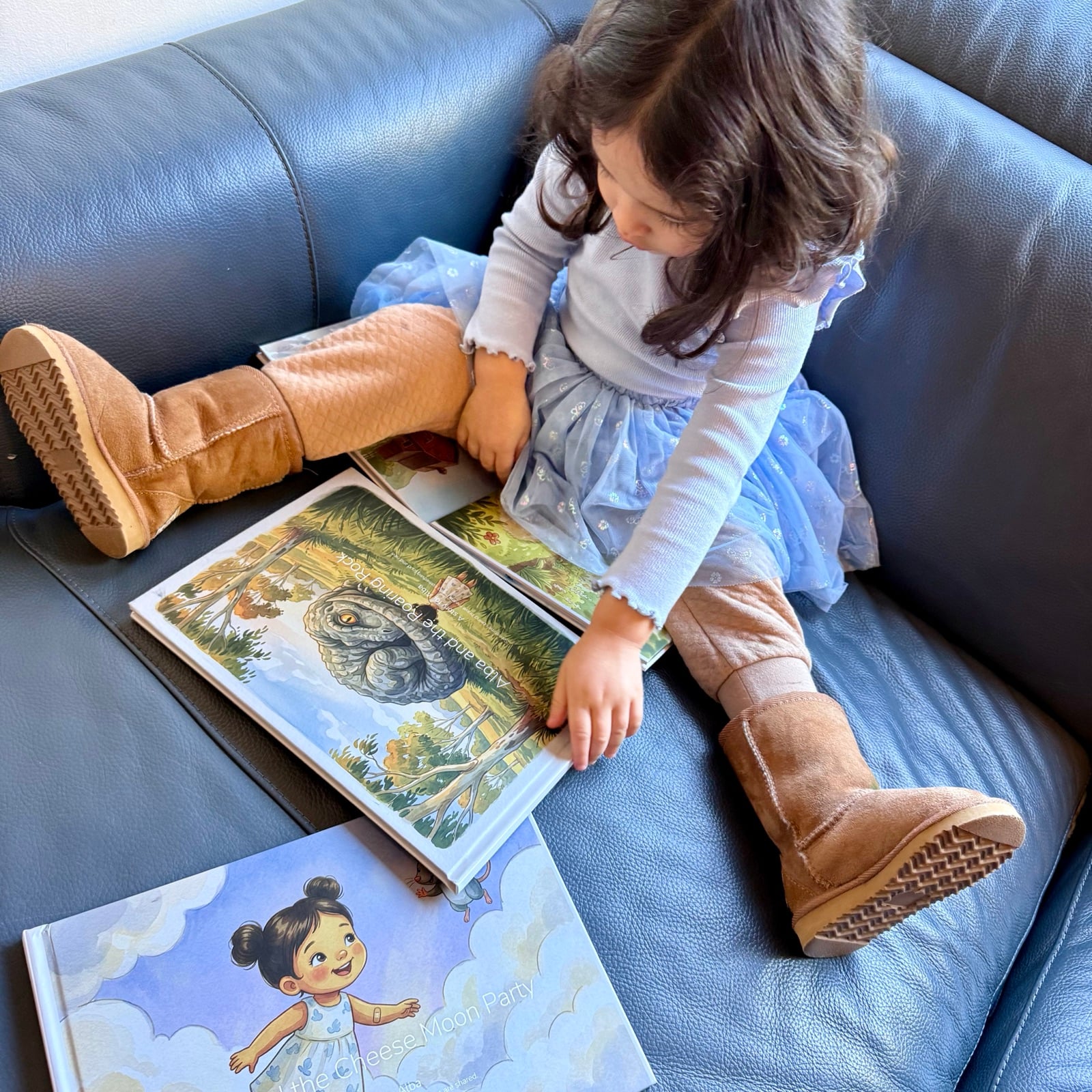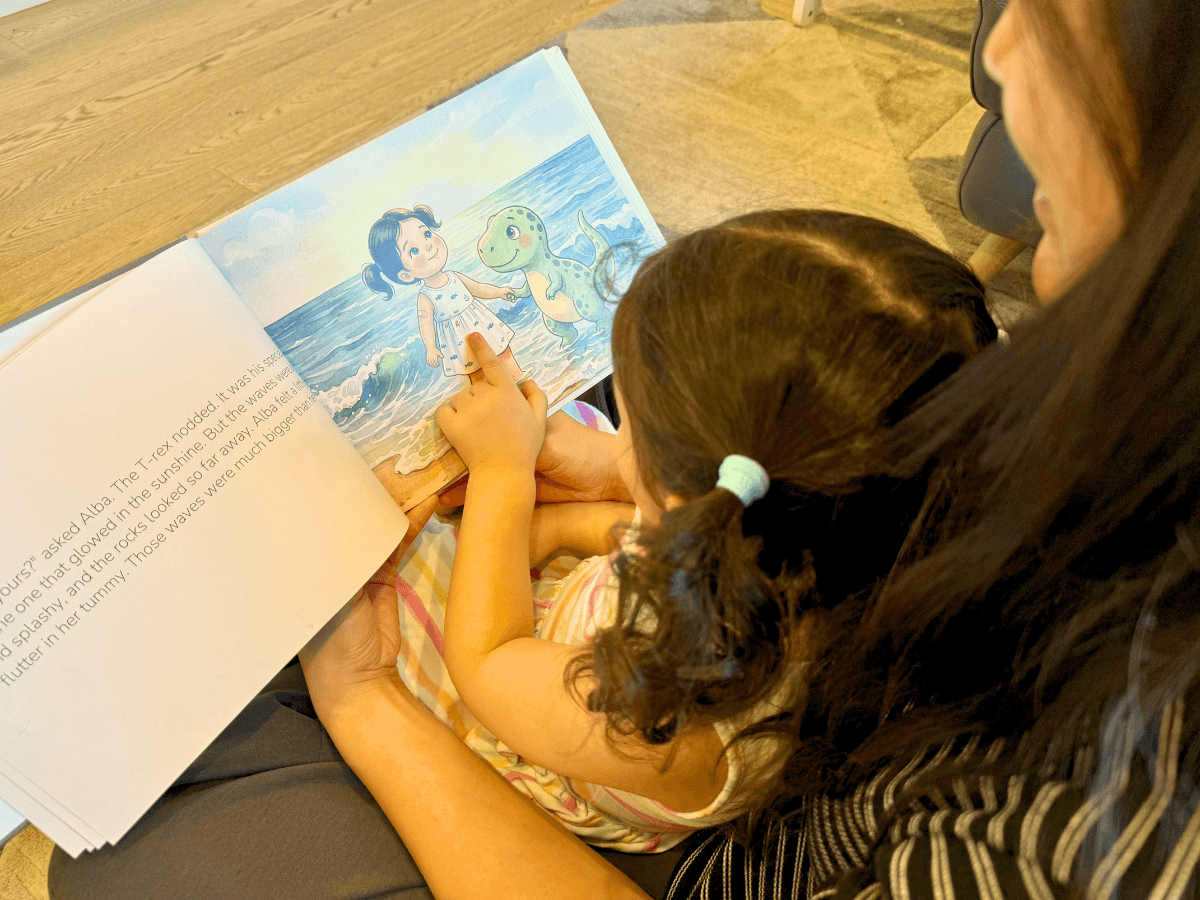
Our daughter is two, and she loves her personalised book. A few weeks ago, her daycare educators flagged that she'd been struggling to share her favourite toys with the other kids. We could have kept telling her sharing is caring, but you can't lecture a two-year-old into kindness. So Ellen made her a book: her favourite stuffed T-rex learning to share, our daughter illustrated as the kid in the story. We've read it most nights since, and we've noticed the sharing is clicking much more. It's the closest thing to a parenting trick we've used.
We get this question often: "is two too young for a personalised book?" The short answer is no. Photo-recognition clicks between 18 and 24 months, and once it does, a child meets themselves on the page just as readily as a four-year-old does. What changes between two and seven is what the book does for the child, not whether the personalisation lands. At two, it's a daily favourite. At four, it carries a lesson cleanly. At seven, it becomes the keepsake they hold onto.
This piece walks through what a personalised book becomes at each age, from 18 months to past seven. Each phase has its own kind of magic.
The short version
| Age | What the book does | Why |
|---|---|---|
| Under 18 months | A keepsake first, the read comes a few months later | Most kids start recognising themselves in pictures around 18 to 24 months |
| 18 months to 2 | A real read, especially when the story is hooked on something they love | Once they recognise themselves on the page, the book lands |
| 2 to 3 | A daily favourite, the most-read book on the shelf | They know it's them, and they want to read about themselves |
| 3 to 5 | The peak of it all, every kind of personalisation works | Pretend-play is at full tilt and lessons stick |
| 5 to 7 | A favourite read AND a milestone marker | The story matters more, and seeing themselves in it lands as identity |
| 7 and up | A keepsake they pull out for big moments | Their own bedtime reads take over, but this one stays special |
Each age has its own kind of magic.
What's actually happening at each age
Under 18 months
Books at this age are sensory. Texture, flap, peek-a-boo, mirror panel. A photo-personalised book needs the child to recognise themselves on the page, and that clicks for most kids between 18 and 24 months.1
A personalised hardcover given to a one-year-old doesn't go to waste. It becomes the book the parent reads aloud2 while pointing at the cover, the book the family photographs with the child each year, the keepsake on the shelf that the child grows into the way they grow into clothes. Many parents we've talked to gift their child's first personalised book at the first birthday specifically because the keepsake outlasts the moment, and the child grows into the read within months.
18 months to 2
Around 18 months, most kids start recognising themselves on the page. The book stops being just a beautiful object on the shelf and starts being a real read, the kind they pull off the shelf and ask for. The more the story hooks onto something they already love (a favourite toy, a colour they've fallen for, a sound they keep imitating), the more the book becomes a current favourite.
This is the age where many parents we've talked to gift the first personalised book that gets read, as opposed to held or photographed.
2 to 3
By two, they really know it's them on the page. They look at the photo of themselves on someone's phone, they look at the character in the book, and the connection clicks. A personalised book becomes one of their favourite reads. The book gets pulled off the shelf daily. The child points at their own face and says their own name out loud. They hand the book to anyone who visits.
What makes a book land hardest at this age is the hook: a current obsession, a favourite toy, a colour they've fallen for, a lesson the parent is reinforcing. The story doesn't need to be long. The personalisation is the magic; the hook gives the personalisation a home. Our daughter is two. Her current most-read book is one Ellen made about a secret garden full of bunnies; she counts them out loud through every page, and her counting has come along for the ride.
3 to 5
The sweet spot. Self-recognition is established. Pretend-play is at full tilt; a child at four can hold their imagined character alongside the one in the book without flinching. Photo-based illustrations like Almia's start to do something specific: the child sees themselves on every page, and the story becomes theirs, not about a kid like them.
What works: every kind of personalisation. Photo-based hits hardest. Stories with a moral land hard if you've picked one that matches what your child is working through (a new sibling, the first day of preschool, a fear of the dark, a recent move). Stories that respond to a child's specific imagination land hardest of all. A child this age might ask for a blue cat and an orange bunny on the same page, or a T-rex running at the beach. No mainstream children's book will deliver those exact images. A personalised book that's drawn from scratch will.
This is also the age where a personalised book gets read more times than any other book on the shelf. Which is, after all, the point.
5 to 7
Personalised books at this age work in a different way. The 6-year-old who's reading independently notices the story more than the 4-year-old does, and a personalised book that lands at this age earns its place because the story and the personalisation work together. Almia's lesson framing matters more than at four. Kids in this band want to know why their character is in the story, not only that they are.
This is also the age where a personalised book becomes a milestone marker as much as a bedtime read. A first-year-of-school book. A book about a little sibling who's just started talking. A book about the dog the family adopted last summer. The story holds; the keepsake holds longer; the parent ends up photographing the spread with the child holding it.
7 and up
By seven, kids have started picking their own bedtime reads and follow series characters they identify with. Personalised books at this age earn a different and arguably bigger place: they become the keepsake, the milestone marker, the gift that lasts past childhood and into the teenage drawer. A book about the school year, the family trip, the year their little sibling finally started talking. The kind of book the child opens at twenty and recognises as a Polaroid of who they were.
This is the age where many of the families we've spoken to gift one personalised book per major birthday or milestone specifically because the book becomes a snapshot of who their kid was at that age. The everyday read shifts toward chapter books; the personalised book moves alongside it as the keepsake their kid will hold onto.
Why we built Almia photo-based
We built Almia around photo-based illustrations because we wanted the book to feel unmistakably about the kid in the photo, not "a kid like them". From around 18 months it lands. By two it's reliable, the way our two-year-old's books are reliable for her. By four it's unmistakable, and the child treats the book as a portrait of themselves at this exact age.
Photo-based personalisation depends on a child being able to recognise themselves on the page, which clicks for most kids between 18 and 24 months. After that, the closer the character on the page looks to the photo you uploaded, the more the child carries the book around as proof that someone made it for me.
Frequently asked
My child is two. Will a personalised book land?
Do personalised books help with reading?
What about an 8-year-old who's reading independently?
Can older siblings tell when the youngest gets a personalised book and they didn't?
Is there research on the right age for photo-personalised books specifically?
Will the right kind of personalised book change as my child grows?
Ellen & Diego, Founders of Almia