You want a book that does more than fill the ten minutes before bed. You want the one that teaches them something: their letters, their numbers, how to share, why the moon keeps changing shape in the sky. So you search "personalised learning books for kids", and a wall of options comes back, all promising more or less the same thing. The honest question sitting underneath that search is this. Is the learning real, or is it a word printed on the cover?
We're Ellen and Diego. We make personalised books for children, so Almia is one of the brands in the category this guide covers, and you should know that going in. What we can add that a neutral guide can't is a close-up view: our own two-year-old has a shelf of these books, and we've watched one of them do the actual teaching. This guide covers what a personalised learning book teaches, what separates an effective one from a decorative one, and how to choose the right one for your child.
What a personalised learning book actually is
It helps to start with the term, because it gets used loosely. A personalised learning book is a children's book built around a specific child (their name, their face, the things they're into right now) that also carries a learning goal: a skill, a concept, or a behaviour the story is quietly working on.
The personalisation and the learning are two different things, and it's worth keeping them separate in your head. The personalisation is not the learning. A book with a child's name on the cover hasn't taught them anything yet. The personalisation is what makes the learning land, because it's what makes the child come back to the book night after night. Re-reading is a big part of how young children learn, and a book that's about them tends to get re-read far more than a book about nobody in particular.
So the short version: a personalised learning book works when the personalisation buys the re-reads, and the re-reads do the teaching.
The four kinds of learning a book can carry
Personalised learning books for kids aren't all aimed at the same kind of learning. It's worth knowing which kind you're actually after, because the book that teaches counting is built differently from the book that teaches sharing. Four kinds cover most of it.
Early literacy. The book carries the child's name on every page and reuses simple words the child hears again and again.1 A child's own name is one of the most motivating pieces of text they'll ever meet, and seeing it across a whole book they love is a strong starting point for reading.
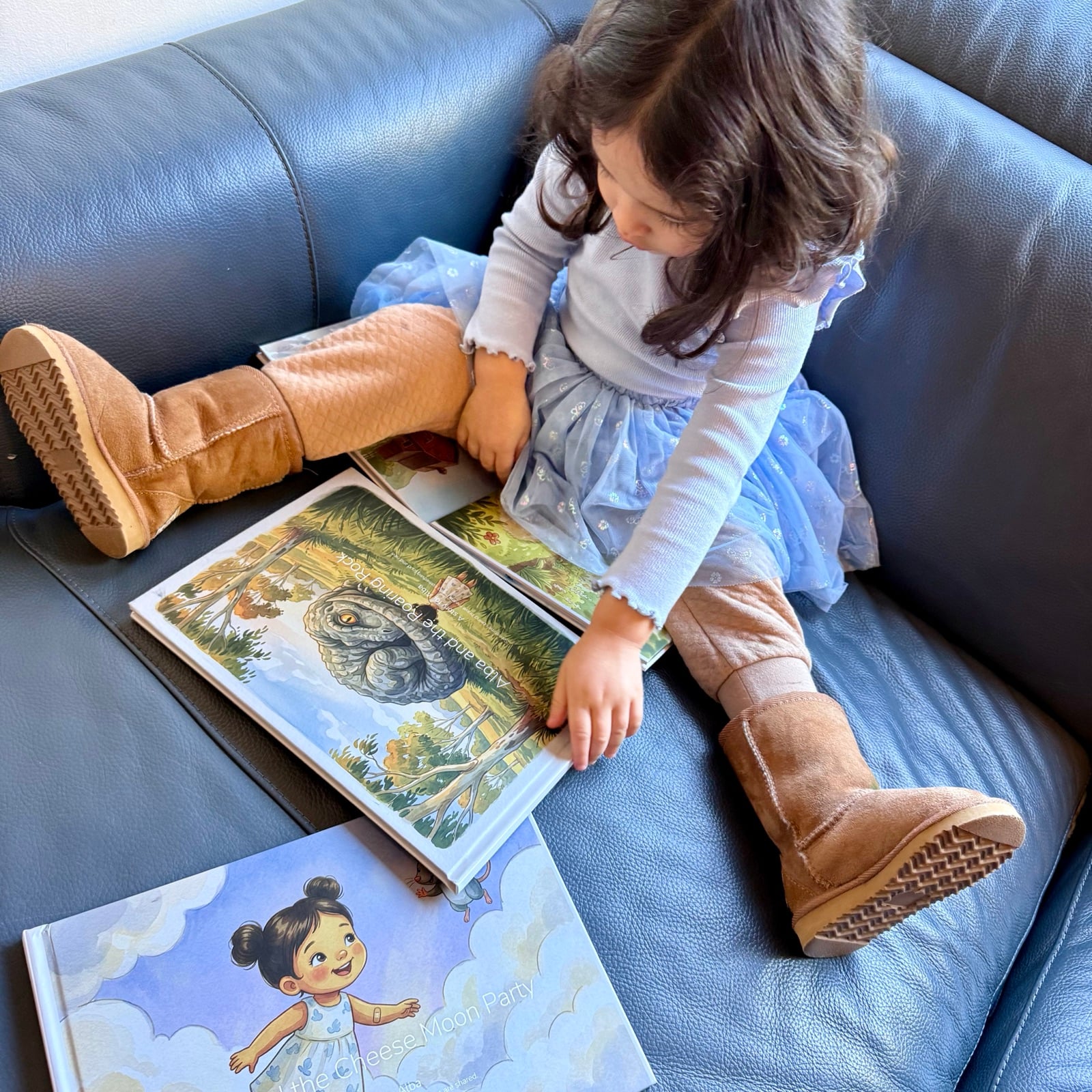
Early numeracy. The book gives the child something to count, page after page: numbers in the story, quantities on the spread, the same things to tally every read. Our own daughter's counting came along through a book full of bunnies she counts out loud, one by one, most nights. We didn't make it as a counting book. We made it about bunnies because she loved bunnies, and the counting attached itself because she kept opening it.
Social and emotional learning. The book carries a behaviour or a feeling: sharing, taking turns, naming big feelings, being gentle. The lesson rides inside the plot rather than being announced. It's its own craft, and we've written a full guide to teaching a toddler a lesson through a book.
Knowledge and curiosity. The book feeds the thing the child is fascinated by: animals, space, the ocean, how a digger works. It's the quietest kind of learning and the easiest to underrate. A child obsessed with the moon who gets a book about the moon tends to learn the moon, because the fascination does the work and the book gives it somewhere to go.
| Kind of learning | What the book does | When it tends to start landing |
|---|---|---|
| Early literacy | Puts the child's name and repeated words on every page | From around 18 months |
| Early numeracy | Gives the child things to count and numbers in the story | From around 2 years |
| Social and emotional | Carries a behaviour or a feeling inside the plot | From around 2 years |
| Knowledge and curiosity | Feeds a fascination with a story built around it | From around 18 months |
A single book is best aimed at one of these, not all four. We'll come back to why further down.
Why the personalisation is the part that does the work
Here's the part that's easy to get backwards. The learning in a personalised learning book doesn't come from the personalisation directly. It comes from the re-reading, and the personalisation is what causes the re-reading.
A child tends to re-read a book they recognise themselves in more often2 than a book they don't. Each re-read lays down a little more: more of the words, more of the numbers, more of the lesson at the end. A book that gets opened forty times in a month does more of this than a book opened twice. The personalisation is the reason the book gets to forty.
This is why a beautifully made book with no hook can still end up at the bottom of the shelf, and why a book wrapped around the thing a child is obsessed with right now keeps coming back to the bedside table. If you want the longer version of this argument, with what the research says, it's in our piece on whether personalised books help with reading.
What separates a learning book that teaches from one that just decorates
Not every book with "learning" on the cover earns the word. Four things tend to separate the ones that teach from the ones that mostly decorate.
One clear learning goal, not five. A book that tries to teach letters and numbers and sharing and the solar system in twenty-six pages tends to teach none of them well. The books that work pick one thing. A counting book counts. A sharing book shares. The single goal is what lets the child, and the parent reading aloud, actually land it.
A learning goal matched to the child's age. A counting book lands differently at eighteen months than at four, and a sharing lesson a two-year-old can act on isn't the one a five-year-old needs. The right book is built for the age the child is now. Our age-by-age guide covers what tends to land when.
The child inside the story, not just on the cover. This is where depth of personalisation matters. A book with the child's name dropped into a fixed template is personalised on the surface. A book where the child is the character living the story, illustrated to look like them, is personalised all the way through, and that tends to be the version a child re-reads. We break the levels down in our guide to the four kinds of personalised books.
A book the child genuinely wants to re-read. Everything above only works if the book gets opened again and again. Re-readability isn't a nice-to-have for a learning book. It's the mechanism. A learning book that gets read once has taught nothing.
How to choose a personalised learning book
Pulling that together into a way to choose:
- Name the one thing you want the book to teach. Letters, counting, sharing, the ocean. Pick the live one, the skill or behaviour or fascination that's actually going on for your child this season.
- Match it to where they are now, not where they're headed. A book a small step beyond what they can do on their own, but still within reach when you read it together, gets re-read and keeps teaching at the same time. A book aimed well ahead of them tends to get shelved.
- Choose depth of personalisation honestly. If you want the book re-read for months, the child needs to be the character, not a name in a slot.
- Check that it's a real story. A learning goal with no story wrapped around it is a worksheet. A story the child loves, with the learning inside it, is a book.
A note on us
We said at the top that we make these books, so here's where Almia sits in all of this.
Almia builds fully-custom personalised books. The parent tells us the thing the book should teach and the thing the child is into right now. From there, Almia generates a book where the child is the illustrated character living the story, with the learning goal woven through the plot. One book, one learning goal, built for the age the child is now.
We didn't invent the idea that children learn through re-reading; that's well-established. What we built Almia to do is make a book a child wants to re-read, so the learning the parent picked gets the repetitions it needs to land.
Frequently asked
What is a personalised learning book?
Do personalised kids' learning books actually work?
What can a personalised learning book teach my child?
What age are personalised learning books for?
Are personalised learning books worth it?
What's the difference between a personalised learning book and a normal learning book?
How do I choose a personalised learning book for my child?
Ellen & Diego, Founders of Almia