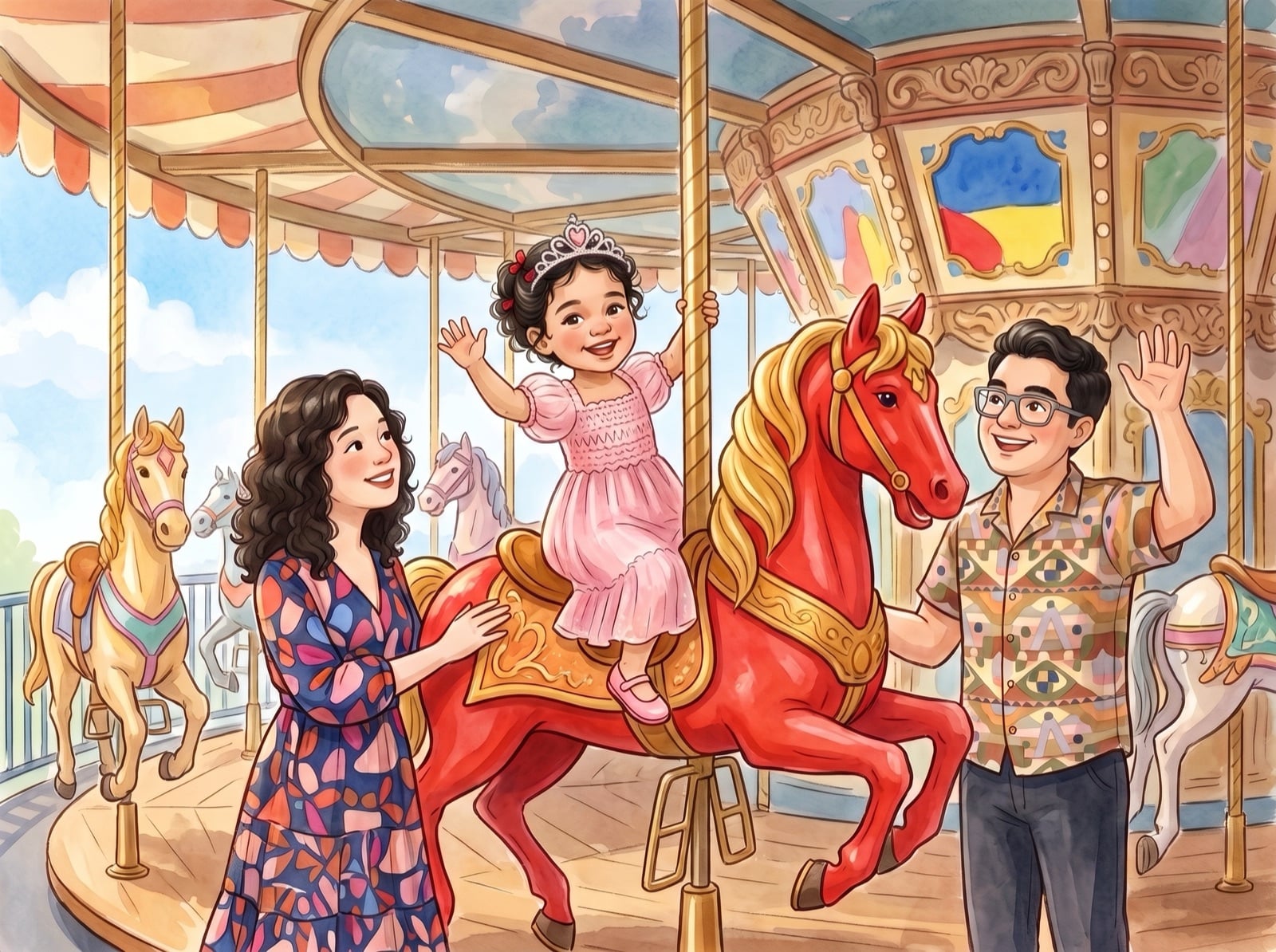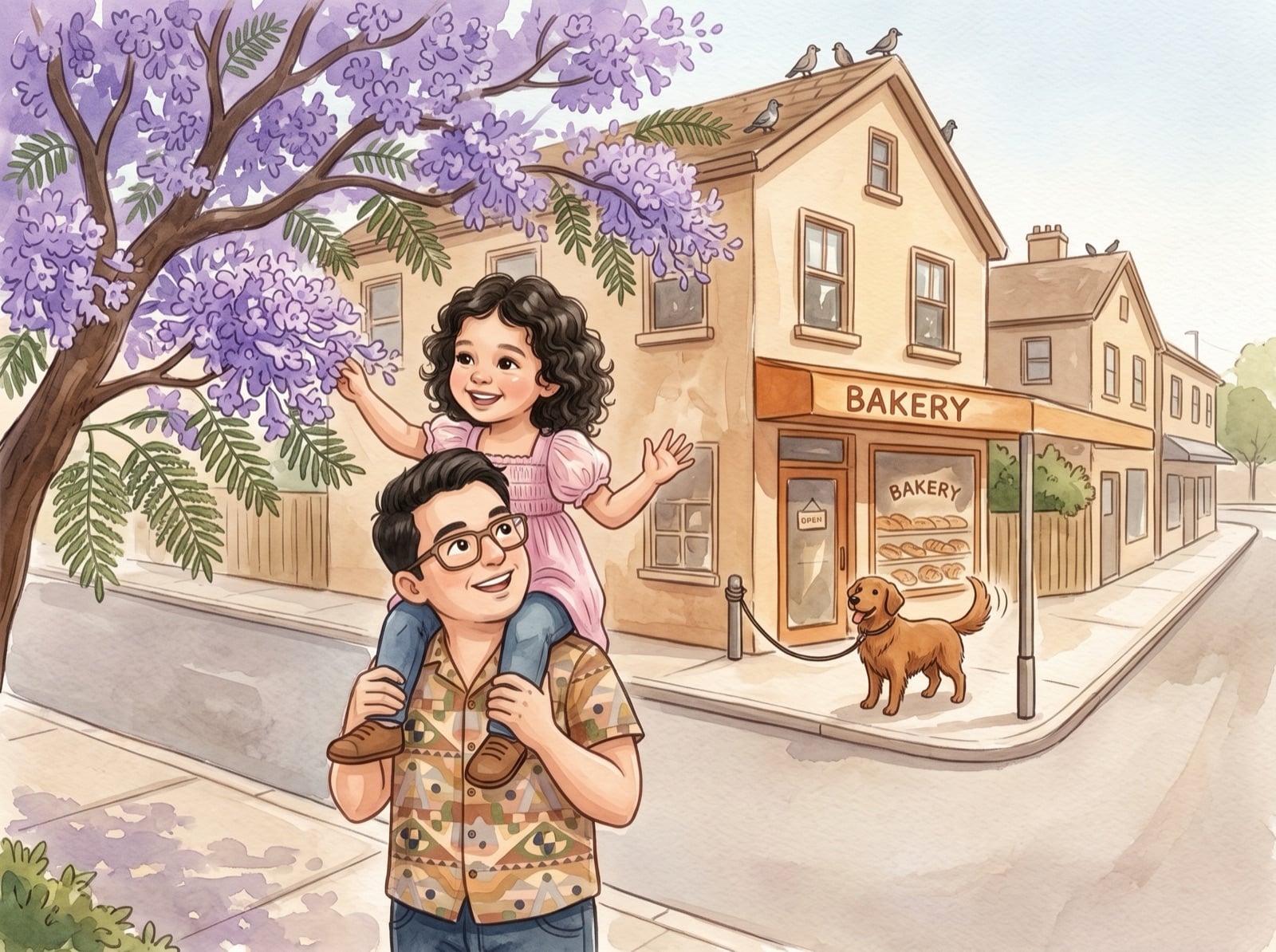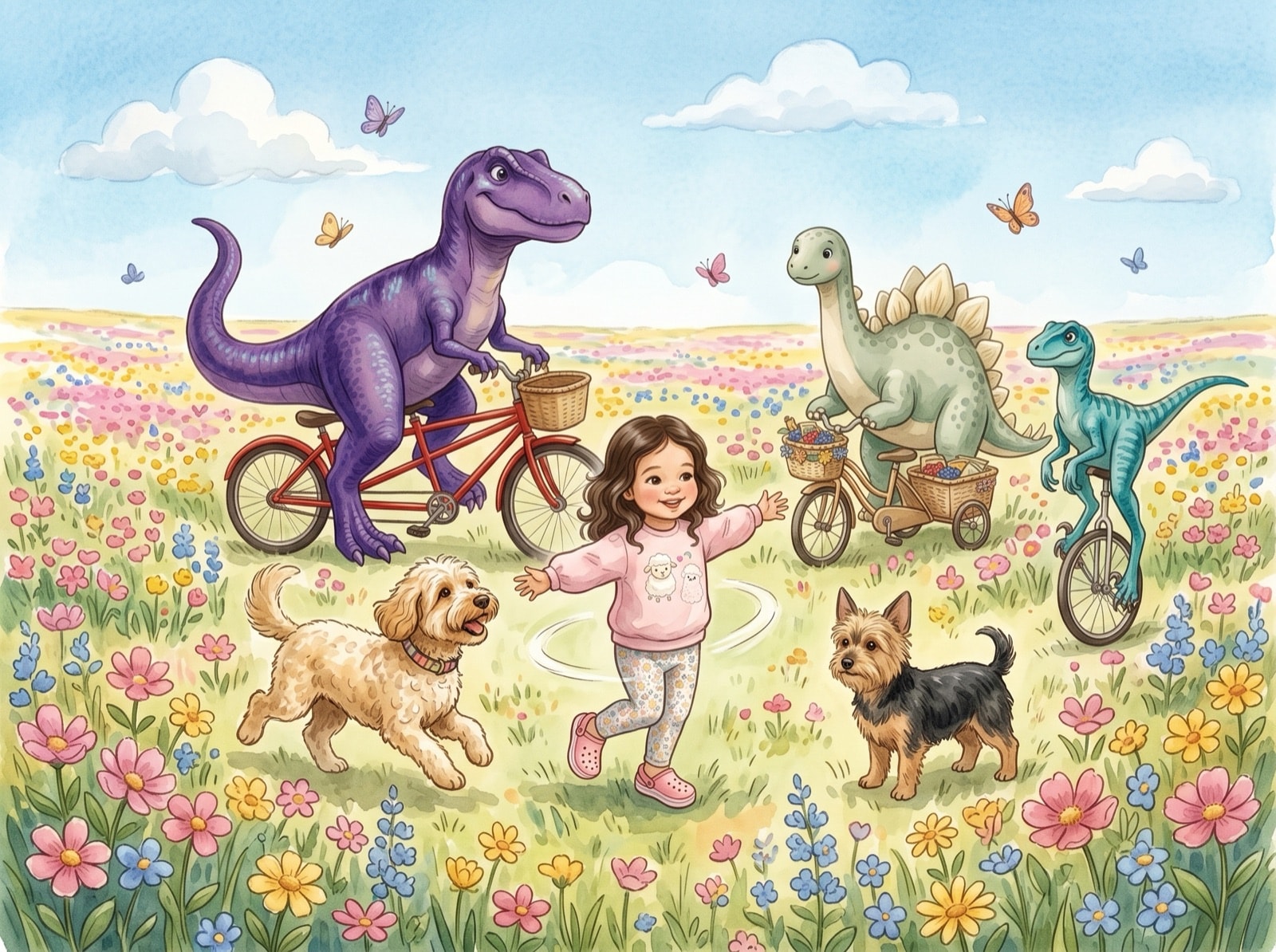
Not long ago, our daughter climbed up next to me with a very clear request. She wanted a book about dinosaurs riding bikes, with her dogs in it. Not dinosaurs. Not bikes. Dinosaurs riding bikes, and the dogs had to be there too. A few days later she was turning the pages of exactly that: a purple T-rex pedalling a red tandem through a meadow, a stegosaurus with flowers in its basket, and her running along beside them with both dogs at her heels.
Yes. A fully-custom children's book can be about almost anything, because the story is written from scratch around your child's own idea instead of dropped into a fixed template. You tell us who they are and what they are into right now, we build a real story where they are the hero of exactly that world, and you read the whole book, with them already in it, before you pay anything from A$59.95 plus delivery.
Here is the part we did not see coming when we started. The finished book is almost the bonus. The real thing, the bit that stays with her, is that she dreamed up something ridiculous and wonderful, and instead of hearing "maybe one day", she watched it turn into a real story with her right in the middle of it. Her idea mattered. She is the kind of child whose stories get made.
We're Almia. Ellen and I make these books, and this is the question we get asked most: can it really be about anything, and how does an idea in a two-year-old's head become a printed hardcover? Here is how it actually works, using our own daughter's books as the example, because those are the ones we can show you honestly.
Can a children's book really be about anything?
Yes, and we mean anything. Because the story is written from scratch around whatever your child is into, the plot bends to them rather than squeezing them into a plot that already existed.
That is the whole difference between a fully-custom book and a name-only one. A name-only book is a single fixed story with a slot for a name; it was written before your child existed, for no child in particular, and it will read the same for the next thousand children who buy it. It cannot do dinosaurs on bicycles, because nobody wrote that story in advance. A fully-custom book has no story until yours has an idea. The idea comes first, and the book is built to fit it.
So when our daughter asked for dinosaurs on bikes with her dogs, that was not a stretch request or a special case. That was just Tuesday. The obsession she walks in with sets the world the whole book lives in, and there is no list of approved worlds to pick from.
What do you actually tell us to make one?
Four things: a photo of your child, their nickname, the thing they are obsessed with right now, and a lesson or a moment you would like the story to carry. That is the whole brief. Each piece shapes a different part of the book.
| What you tell us | What it shapes | In our daughter's books |
|---|---|---|
| A photo of your child | Who the hero looks like on every single page | She is recognisably herself, page after page, not a stand-in with her hair colour |
| Their nickname | How the story speaks to them, in the name only you use | The pet name we only use at home, right there on the page |
| Their current obsession | The world the whole story lives in | Dinosaurs on bikes one week, crocodiles the next |
| A lesson or a moment | The heart of the plot and the choice your child makes | Sharing a picnic, being brave for a lost baby shark, being kind to a lonely crocodile |
None of that is a form full of settings. It is the handful of true things you already know about your child. The photo is what keeps them looking like themselves across the whole book, not just the cover; we wrote a separate piece on how a photo becomes the character on every page if you want the detail. This post is about the other half: the story.
How does one obsession become a whole story?
The obsession sets the world; the lesson sets the plot. Change the lesson and the same obsession becomes a completely different book.
For a stretch this year, our daughter was obsessed with crocodiles. Not frightened of them. Delighted by them. So she did not get one crocodile book, she got three, and no two are the same story.
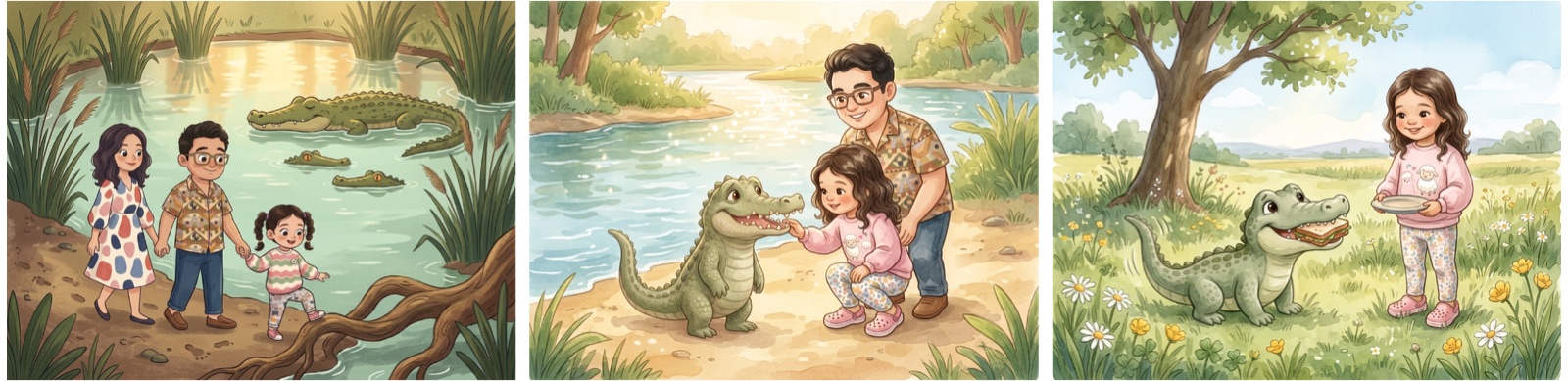
Same crocodile. Three worlds. One is the fun of a wild day out with the people she loves. One is noticing someone who looks left out, and being gentle with them. One is sharing what you have when a friend has none. The crocodile was her way in. The lesson was ours to choose, and it is what makes each of the three a different book rather than the same book three times.
That is the mechanism, and it is why "how many can one obsession give you?" is the wrong question. There is no ceiling. A single fascination can carry as many stories as there are things worth saying inside it.
Why does the lesson matter as much as the wild idea?
The wild idea gets your child to open the book; the lesson is what makes it worth re-reading and gives the story somewhere to land. A book that is only "dinosaurs on bikes" is a lovely picture with no reason to turn the page. The lesson is the reason.
And because your child is the one making the choice on the page, not being told what to think, it lands in a way that a lecture never does. She was not read a story about sharing. In her own book, she was the one who chose to share the picnic. We dug into that in building a lesson into a story a toddler actually takes in, which is the single biggest reason we build the way we do.
There is good evidence this is not just our parental bias. Researchers who study shared reading find more smiles, more talking, and more laughter when a parent and child read a book personalised to that child than when they read a comparable one that is not. 1 A child who recognises themselves, and their own idea, leans in.
What stays the same in every book?
The idea changes every single time; the craft does not. Whatever world your child dreams up, every book is the same recognisable child on all 26 pages, the same hardcover quality, and the same free full preview before you pay a cent.
That consistency is the part we will not cut corners on. The whole promise of a photo-personalised book is that it is genuinely them, not on the cover and then a different child inside. So here is what the book is, in plain specifics:
- Hardcover, 26 pages, 170gsm silk paper, matte-laminated cover
- Your child illustrated as the hero on every page, not just the front
- A story written from scratch around their idea, never a template with a name dropped in
- The whole book readable free before you pay anything, from A$59.95 plus delivery
- Dispatched in 5 to 7 business days, tracked
- Currently delivering to Australia and New Zealand, with global delivery on the way
The free preview is the part that matters most, and it is deliberate. You see the entire book, your child in it, the whole story, before you spend anything. You are never paying for a maybe. You read it, and if it does not look like them and feel like theirs, you walk away having spent nothing.
If you are still weighing up the difference between a book your child appears in and one they truly lead, we made that the whole subject of what it means to make your child the main character, and the wider four kinds of personalised books sits alongside it.
The idea can be anything. That is the whole point. Your child hands you the most wonderful, ridiculous thing in their head, and instead of it staying in their head, it becomes a book with them at the centre of it. What will you two make?
Frequently asked
Can a personalised children's book really be about anything?
What information do you need to make a custom children's book?
Can the same interest become more than one book?
Do I need a special occasion or a lesson in mind to make one?
Will the story actually feel like my child's, or is it generic?
Ellen & Diego, Founders of Almia