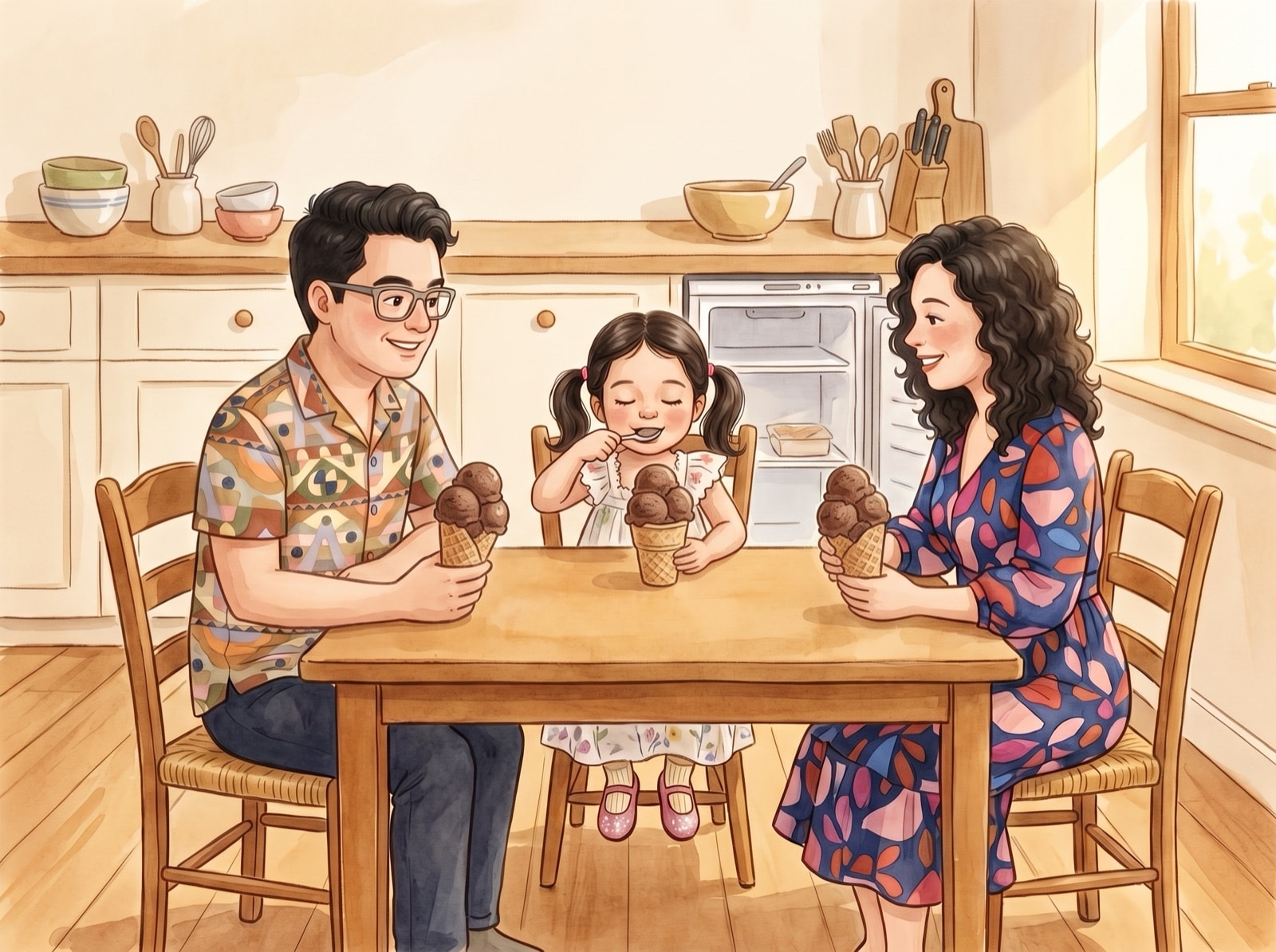
Nothing was happening. It was an ordinary day, there was no party and no trip and no milestone, and our three-year-old had decided that chocolate ice cream was the single best thing in the world. That was the whole of it. So we made her a book about that day.
Yes, a personalised children's book can be about a day that actually happened, and it does not need an occasion attached to it. You give the small true things: a photo of your child, what they were fixed on that day, and who was there with them. What comes back is that day as a story, with your child living it as the hero.
Can a children's book be about a day that actually happened?
Yes. Because the story is built from scratch around whatever you hand over, a real day is simply a different kind of starting material to an invented idea, and in some ways an easier one.
An invented idea gives you freedom and no shape. Dinosaurs on bicycles could go anywhere, which is lovely and also means the plot has to be found, and we pulled that version apart in how a fully custom story gets written. A real day arrives with its shape already fixed. It starts in the morning. It has a small number of people in it. Something is the centre of it. It ends.
What we handed over for this one was tiny. Chocolate ice cream. A day with the two of us. That was the brief.
What came back was ten scenes of an ordinary day. Breakfast in the kitchen with her dad. A blanket fort built across the lounge room. Standing on a stool at the bench, stirring a bowl of chocolate with her mum. And then the three of us at the kitchen table, one cone each, her eyes shut.
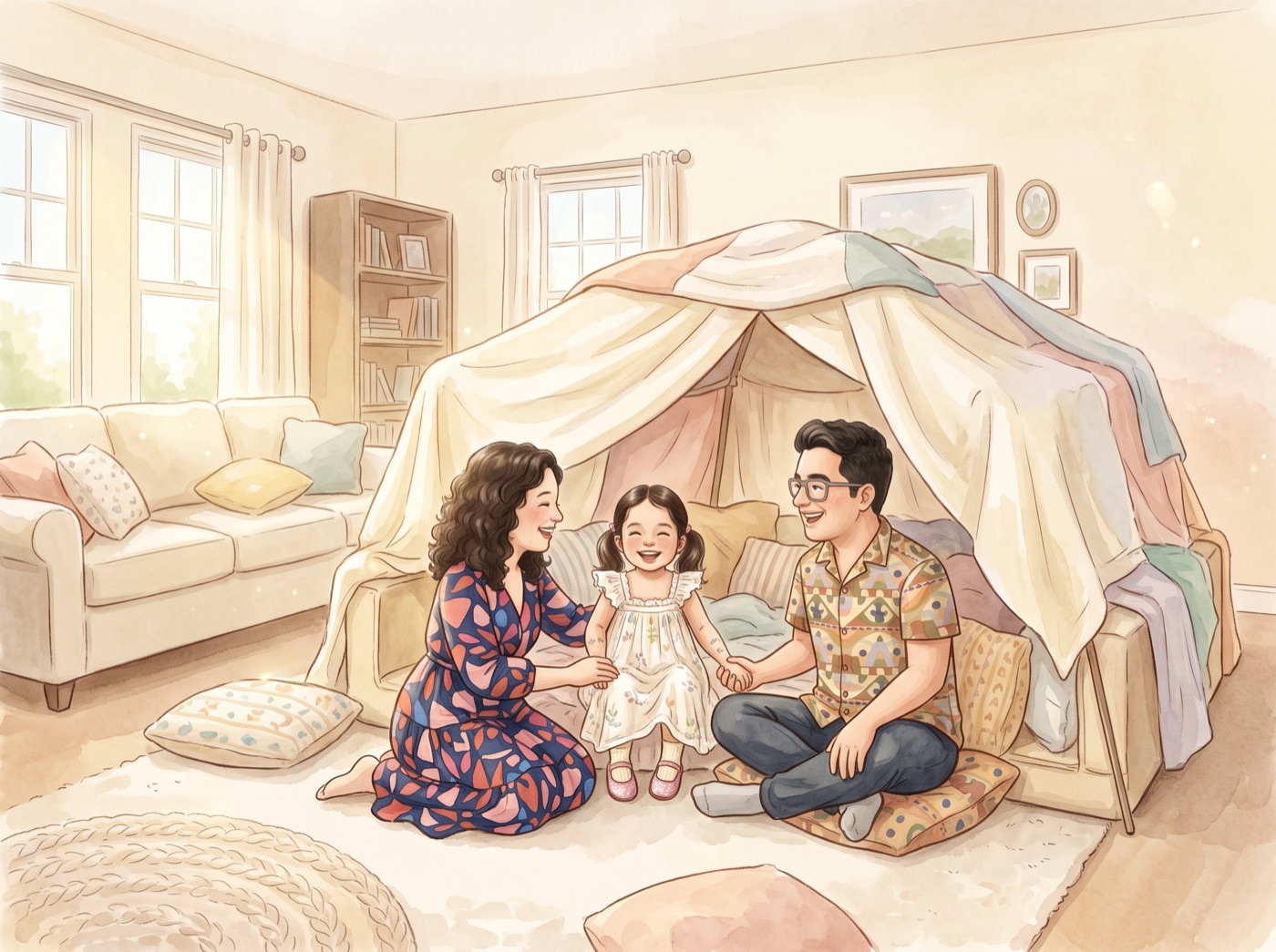
It went onto the pile she asks for at bedtime, the way each new one does. Nothing in it is remarkable. That seems to be the point.
Do you need a birthday or an occasion?
No. An occasion is the usual reason a personalised book gets ordered, but it is a reason, not a requirement, and the no-occasion book behaves differently once it is on the shelf.
Almost every personalised book has something pegged to it. A third birthday. Christmas. A new baby arriving. The occasion does useful work: it sets a deadline, it tells you what the story should be about, and it gives you the moment you hand it over.
An ordinary day has none of that pushing it along, which is exactly why it gets skipped. It is also why it reads differently later. A birthday book is about the biggest day of the year, and there is one of those. The day with the ice cream is one of a few hundred, and nobody was going to remember it.
If you do have an occasion, the timing question is its own thing, and we wrote it up separately in what to put in a personalised birthday book for a three-year-old.
What do you tell us about a real day?
The same four things as any other book, just pulled from the day instead of from their imagination: a photo of your child, their nickname, the thing they were fixed on that day, and who was there.
The photo is what keeps them looking like themselves on every page rather than a stand-in with the right hair colour, and we pulled that apart properly in how a photo becomes the character on every page.
The one real limit is who else fits. A book holds your child plus up to two other people. For the ice cream day that was both of us and it was exactly right. For a day with four cousins and a grandmother it would not be, so you pick the two the day belonged to.
You do not need to write the day out hour by hour. Small and true beats long and thorough. One thing they could not stop talking about is usually enough.
| How it works | An invented story | A day that happened |
|---|---|---|
| What you start from | Whatever they are obsessed with this week | A day with a shape already in it |
| What you tell us | The idea, and a lesson you want it to carry | What they were fixed on, and who was there |
| What the book becomes | A world built around their idea | That day, kept, with them at the centre of it |
What changes when the story is true instead of invented?
The re-reading changes. With an invented story the pull is the idea; with a real day the pull is recognition, and recognition does not wear out the way a punchline does.
An invented book is somewhere your child gets to go. A real-day book is somewhere they have already been, so what they recognise is not only themselves but the room they are standing in.
The book is not a documentary. You give it a handful of true things and the story is built around them, so some of what lands on the page is invention sitting comfortably next to the parts that happened. At three, the line between what happened and what got a bit better in the telling is not a line she is looking for.
Researchers looking at shared reading find more smiles, more talk and more laughter when a parent and child read a book personalised to that child than a comparable one that is not. 1 A child who recognises themselves leans in. A child who recognises their own kitchen leans in further.
Which days are worth keeping this way?
The ones you would not have photographed. A day is a good candidate when it has a rough shape, one thing your child was fixed on, and one or two people who were in it with them.
Some that work:
- A day with one small obsession running through it, like ice cream, or a particular puddle
- A first: the first swim, the first day somewhere new, the first time they did the thing on their own
- A day out that was genuinely theirs, not yours. Our daughter's other recent one came out of a weekend of yum cha and a morning at the Sydney Fish Market, which is about as specific as a day gets
- The last day of something, which you usually only recognise afterwards
- A plain Saturday when nothing happened and everyone was happy
Days that struggle are the ones with no centre. A busy day where five things happened and none of them mattered more than the others gives the story nothing to hold. Pick the smaller day.
The books themselves are the same either way, and that part does not bend:
- Hardcover, 26 pages, 170gsm silk paper, matte-laminated cover
- Your child illustrated as the hero on every page, not only the cover
- A story built from scratch around what you gave us, never a template with a name dropped in
- The whole book readable free before you pay anything, from A$59.95 plus delivery
- Dispatched in 5 to 7 business days, tracked
- Currently delivering to Australia and New Zealand, with global delivery on the way
We are Almia. Every one of these books is built from scratch around the child it is for, and a plain Saturday turns out to be as good a place to start as a dragon.
Frequently asked
Can a personalised children's book be about a real day rather than a made-up story?
Do you need a special occasion to order a personalised book?
How much detail about the day do you need?
How many family members can be in the book?
Is the book an exact record of what happened?
Ellen & Diego, Founders of Almia