Saturday morning. The couch pushed back against the wall, a blue mat rolled out across the lounge room floor, and a small girl in a white gi bowing so low that her nose bumps the mat. Her dad kneels in the middle of it, grinning. That is how the jiujitsu book we made our three-year-old opens.
Yes, a personalised children's book can be about your child's sport or activity: swimming lessons, dance, footy, gymnastics or a martial art. Almia builds personalised children's books from a photo of your child. You name the activity and pick a lesson, such as being brave, and the story is built around both, with your child as the one who gets through the hard part.
Can a personalised book be about your child's sport or activity?
Yes. When you make an Almia book you tell us what your child is into right now and what you want the story to carry, and the whole book is built around those two things, plus your photos. Name the activity, and the story is set inside it.
A book with a stock story and your child's name dropped in cannot do this. It does not know your child goes to swimming lessons, or that the hard bit is putting their face in the water. A book built from scratch starts from exactly that.
Here is what we gave ours. The interest was one word: jiujitsu. The lesson was about learning it and being brave. Then a photo of her, and one of her dad so he could be in it with her, which we wrote about in the book about her and her dad.
It came back as a whole world: a white gi and belt, a bow at the start, a blue mat in the lounge room. We never mentioned a gi, a belt or a bow. If you want the long version of how an interest and a lesson turn into a story, how a fully custom story gets written walks through it.
Why does practising the scary part in a story help a child feel brave?
We think a story lets a child do the hard thing on the page first, as many times as they like, and see it go well. By the time they meet it for real, it is not brand new.
Bravery at three is not about not being scared. It is doing the thing while you are still a bit scared. A pep talk tells a child they will be fine. A story shows them being fine, and then a child asks for it again and gets another go.
The trick is to pick the hard part, not the whole sport. A book that is just "you love jiujitsu" is a nice book. A book about the moment that worries them is a useful one. In jiujitsu, a likely candidate for a small child is being on your back with someone bigger above you. That is exactly where this book went.
Lessons in general work the same way, sharing and patience as much as bravery, and how to teach a toddler a lesson through a book covers the wider idea.
What happens in the jiujitsu book we made her?
She practises one move on the mat at home with her dad, meets a wombat bigger than she is, and uses the move to roll him over. The book's own tagline: "Feet flat, hips up, and over he goes."
The first pages stay in the lounge room. After the bow, she is on her back on the mat with her dad on his hands and knees above her, and she pushes her hips up off the mat. Feet flat, hips up. On the next page she is lying flat out, puffing out a breath, and her dad has turned round in surprise, because a wombat is waving at them through the glass door.
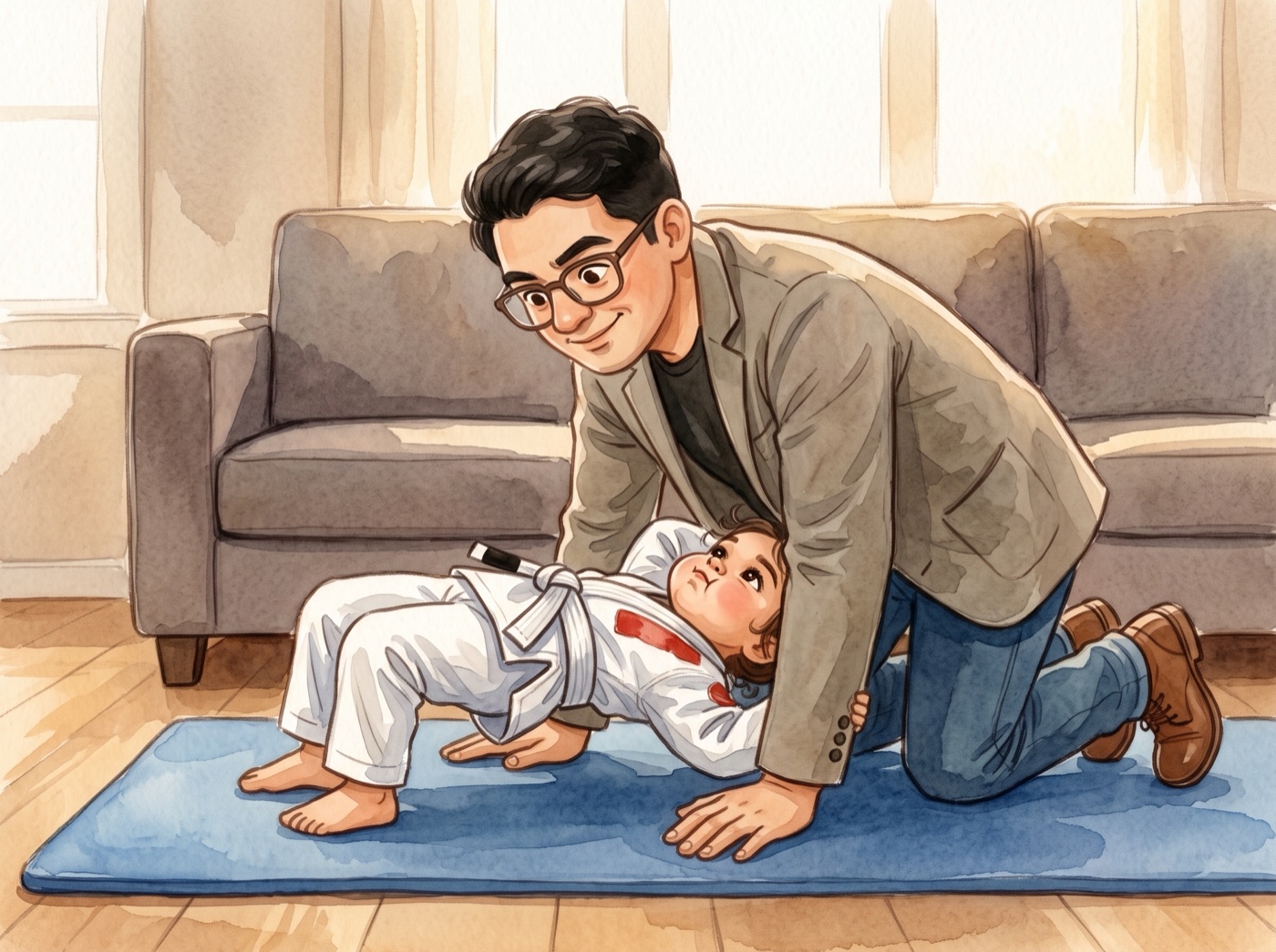
When they open the door, she stands close against her dad's leg. The wombat is sitting out in the paddock. That page matters. A brave book needs a moment where the child is not sure yet, or the brave bit at the end means nothing.
Then they go outside. She ends up on the grass, laughing, with the wombat right beside her. Down by a creek she ends up on her back in the sand with the wombat standing over her, and her dad kneels close by. Under a big gum tree, more wombats gather.
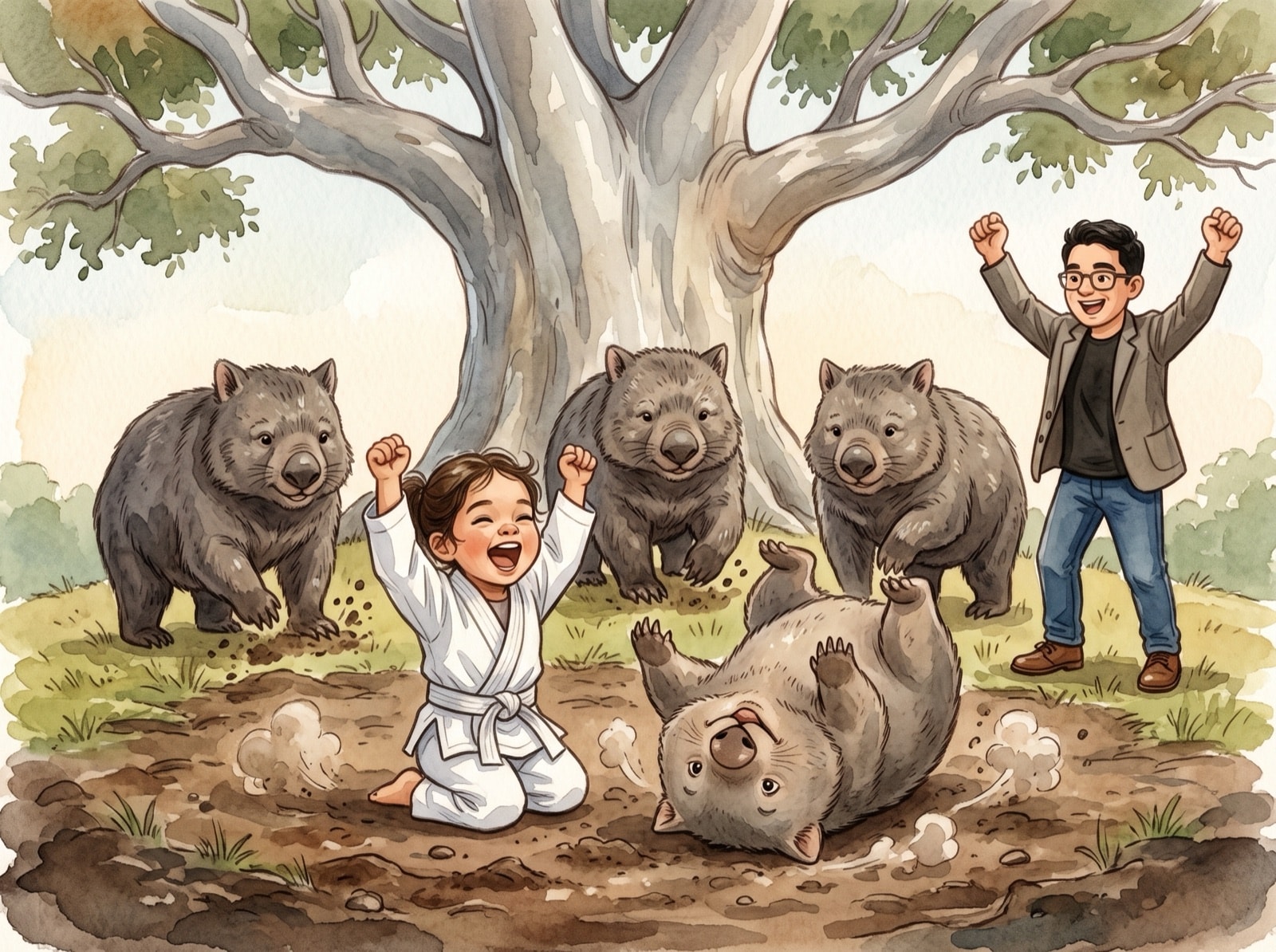
And then the move. On her back, underneath the biggest wombat, feet flat, hips up, and over he goes. The next page is the one at the top of this post: the wombat on his back with his paws in the air, her on her knees with both fists up, her dad cheering behind her.
The last page goes home again. She is climbing on her dad on the blue mat, both of them laughing, and the wombat is peering in through the glass door.
So the book put her in the position a small child is most likely to find hard, practised it somewhere safe, and then let her use it on something bigger than her. That is the shape we would look for in a book about any activity.
Which part of an activity should the story be about?
The part your child is unsure about, told as something they get through, not something they avoid. Every activity has one. Here is where we would start.
| Activity | The part that can feel scary | What the story can practise |
|---|---|---|
| Swimming lessons | Putting their face in the water, letting go of the edge | Blowing bubbles, floating, and swimming to someone waiting with open arms |
| Dance or ballet | Letting go of your hand at the classroom door | Walking in, joining the circle, and finding you at the window |
| Footy or soccer | Getting bumped, missing a kick | Falling over, getting straight back up, and having another go |
| Gymnastics | Going upside down for the first time | A forward roll that lands, and a big finish with arms in the air |
| Jiujitsu, judo or karate | Being on your back with someone bigger above you | One move, practised at home, that works when it counts |
| Starting at a new club or class | The new room full of children they do not know | Arriving, saying hello to one child, and leaving with a friend |
Every row in the third column ends with the child getting through it. They can hear about falling over and getting up a hundred times before the first class.
What should you tell us so the story gets the activity right?
Name the activity in plain words, pick a lesson such as being brave or trying again, and bring along the person who does it with them.
Plain words beat categories. "Jiujitsu" came back with a gi, a belt and a bow. Write "swimming lessons" or "Saturday footy", not "being active".
For the lesson, pick the feeling you want them to walk away with. Being brave, say, or trying again when it does not work the first time. Change the lesson and the same activity becomes a different book.
Then think about who comes along. A book holds your child plus up to two others, each from one photo. For a sport book that is usually the parent who takes them, the one standing at the edge of the pool or the side of the mat. In ours it was her dad, and it would not be the same book without him. A sibling who plays the same sport can take one of the places.
A note on the book itself
We are Almia, and we build personalised children's books from a photo of your child. Every book is built from scratch around the child it is for. There is no stock story about a girl in a white gi, a blue mat in the lounge room and a wombat she rolls over. That one was built for her.
If your child has started something new, or has a class coming up that they are nervous about, you already know what their book is about. Give us the activity and the lesson, and read it with them before the first class.
The specifics: hardcover, 26 pages, 170gsm silk paper, matte-laminated cover, A$59.95 plus A$16.00 delivery. It arrives in 7 to 10 business days in Australia and 10 to 14 in New Zealand, tracked. We currently deliver to Australia and New Zealand, with global delivery on the way. And you read the whole book free before you pay anything.
Frequently asked
Can a personalised children's book be about my child's sport?
Can a story help my child feel brave about a new activity?
What sports and activities can a personalised book be about?
Can I be in my child's sport book too?
What age is a personalised book about a sport or activity good for?
Ellen & Diego, Founders of Almia