We have been careful about screens from the start. Before our daughter ever saw one, we did the research: slower, calmer shows made for a toddler's attention span, not the loud, fast-cut kind. Something like Trash Truck, not whatever autoplay wants to hand her next. Even with the right show on, we keep it tight. About fifteen minutes, and not every day.
That part we get right. What we have never solved is the ending. Fifteen minutes means nothing to a happy two-year-old who does not yet have the reasoning to understand why a good thing has to stop. Telling her "time's up" lands about as well as you would expect. That is what this piece is about. Not screen time. The bit right after it.
Can a book actually help a toddler accept when the screen goes off?
Not by replacing the screen, and not by out-entertaining it. A generic "time's up" is a rule handed down, and a two-year-old has no way to reason her way into accepting a rule she cannot see or touch. What works is giving the ending its own object: something she can reach for the moment the screen goes dark, that turns the boundary into a story instead of a loss.
A book does not need to beat the screen at being entertaining. The screen has already had its fifteen minutes; what is left is the handover, and that is a job a book can do.
The reason a screen is sticky in the first place is not a flaw in your child. It is design. Autoplay serves up a new thing before the last one is finished, and a two-year-old's brain reaches for the new thing every time. A picture book cannot out-novelty a screen, and it should not try. What it can do is be the one thing, right as the screen goes dark, that she already recognises as hers.
The paediatric guidance backs the part we already do. For a two-year-old, the American Academy of Pediatrics points parents toward high-quality, slower-paced programming, watched together rather than alone, capped at around an hour a day.1 Fifteen minutes of Trash Truck with one of us in the room is about as close to that as a toddler's telly habit gets. None of that guidance, though, tells you what to do about the minute after the screen goes off. That part, we had to work out ourselves.
Why does a story that stars them work better than just saying no?
Because "no" is an instruction, and a two-year-old cannot argue herself into liking one. A story is different. She is not being told the screen has to go off; she watches a character just like her, drawn as her, go through the same thing and come out fine. She arrives at the ending herself, inside the story, instead of having it handed down from outside it.
We have written before about what is really going on underneath this, over in the piece on whether these books help with reading. The short version: a child re-reads a book that is about them far more than one that is not, because recognising herself on the page is the strongest pull a picture book has. That same pull is what makes the handover work. She is not settling for a consolation prize. She wants to see what happens to her in the story.
It works best when the book leans on the two things a generic one cannot: her own face on the page, and whatever the moment actually is for her. If dinosaurs are the thing this week, dinosaurs help. But for the handover specifically, the strongest hook of all was not an obsession. It was the screen itself, turned into a character she could watch go to sleep.
The book we made when the TV went to sleep
So one evening, after yet another round of the fifteen-minutes fight (it does not happen every day, but often enough), we did the obvious thing given what we do for a living. We made her a book about it. Not a lecture about screen time. A story where the television itself gets tired, yawns, and goes to bed, and she is the one who discovers what the house is like once it is quiet. She is the hero of it, not the kid being told to turn the telly off. It hands the exact moment she cannot yet reason her way through back to her, with her in charge of how it ends.
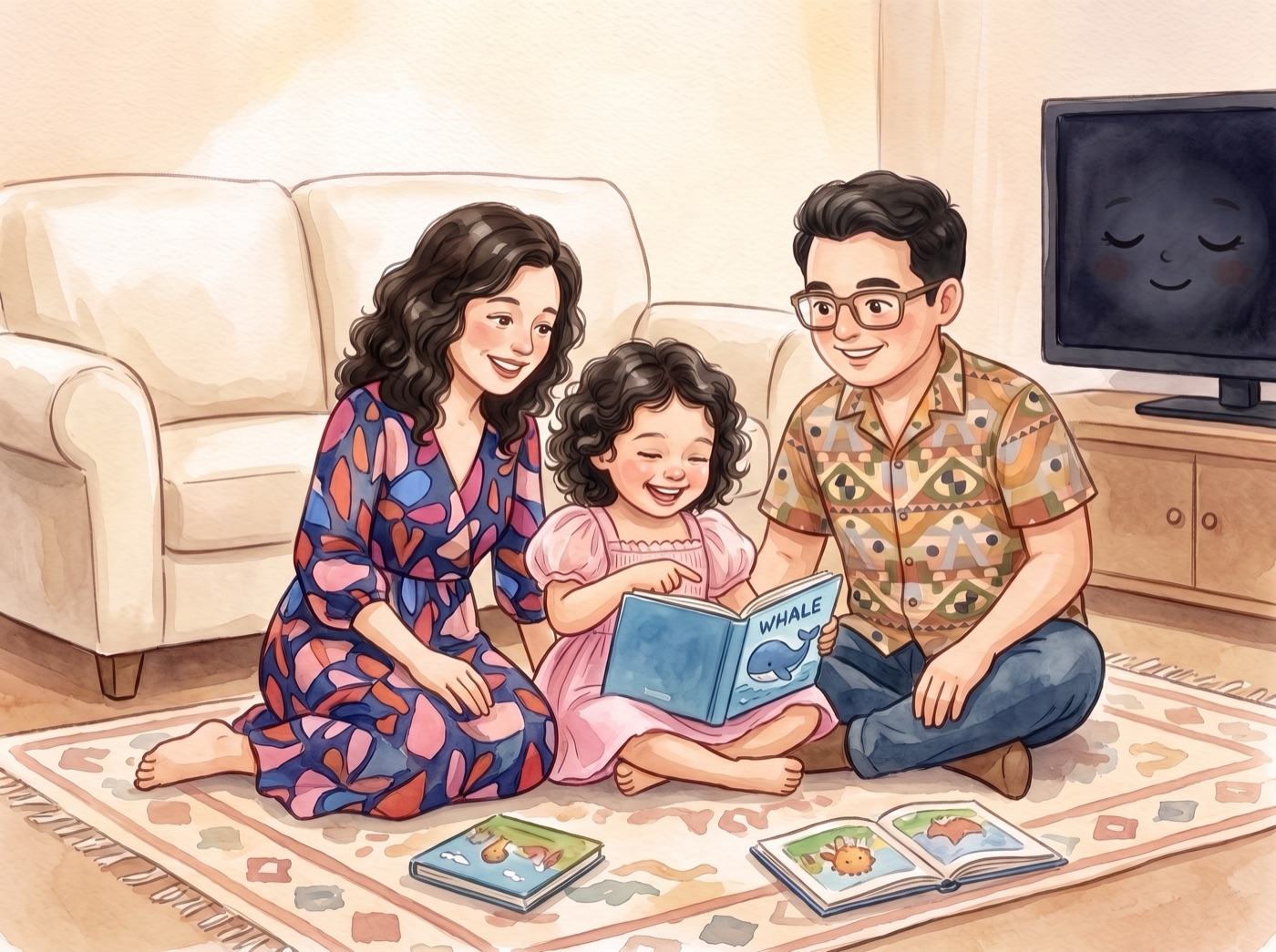
The book has not ended the fifteen-minutes fight. Some days it still does not land, and she still protests, because she is two, and that is what two looks like. What changed is smaller and more specific. When we tell her the television needs to go to bed now, she knows exactly what we mean, because she has watched it happen to a character in her own story first. A few times she has said good night to the TV herself on her way past it, the same easy way she says good night to her toys. The transition goes from a meltdown to a conversation about a sleepy television, and at seven in the evening, that is worth a lot. A book cannot make a two-year-old reasonable. It can give her something to do with the feeling instead of just having it.
There is a knock-on effect we did not plan for, either. She has started asking to make the books, not just read them. She comes to us with the thing that has taken her over that week, and the three of us sit down and make it together. We wrote about where that habit went in the piece on how many of these a child actually needs. Yes, the making happens on a screen too, but it is the opposite of the autoplay kind: she is choosing and building something rather than being handed the next thing, and what it produces is a book she then reads off the screen entirely.
What would you tell a parent fighting the same battle?
We would be wary of telling any other parent what to do here, because every kid and every evening is different. What helped in our house was to stop trying to win the screen-time argument with logic, which a two-year-old is not wired for yet, and to put that energy into the handover instead: the one minute the screen goes off. Having something she already loves ready for that minute, so the ending becomes part of a story rather than a rule, did more for us than any amount of negotiating.
A few things that turned out to matter for us, for whatever they are worth:
- The next thing worked best when it was ready before the screen went off, not after. The transition was hardest in the gap, so we tried not to leave one.
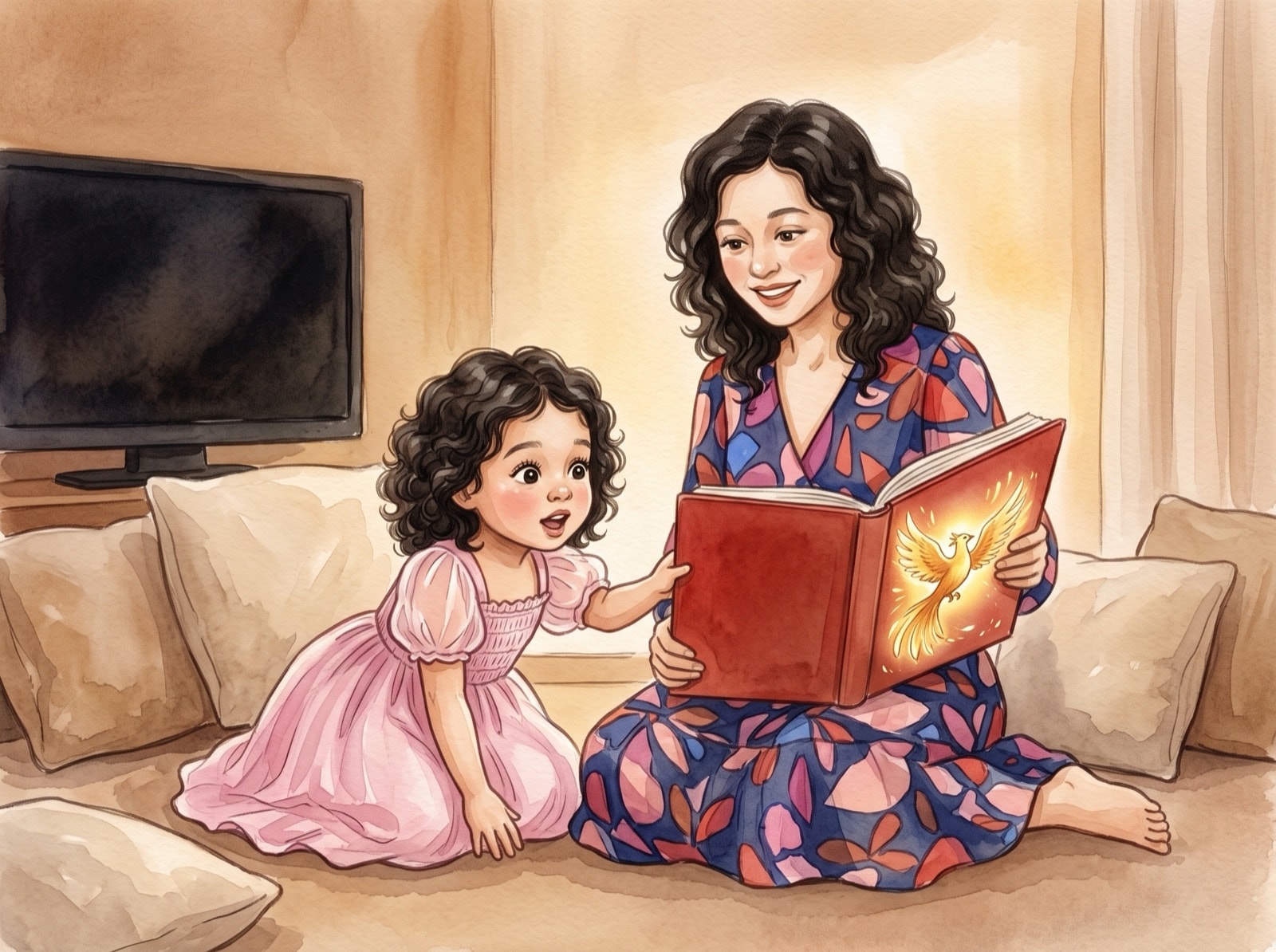
- We read it with her, out loud, even the books she knows off by heart. The part that mattered was not really the book; it was the two of us sharing attention on the same page, which is the one thing a screen cannot copy. Parents and toddlers talk to each other more over a paper book than over the same story on a tablet, and that back-and-forth is where the language and the focus come from.2
- The books that landed were about the actual thing she was losing, not something unrelated. A story about the specific moment she was in did more than a general distraction.
- And we never went looking for zero. Her screen time was already tight, so this was never about cutting it further; it was just about making the boundary something she could meet without a meltdown.
| What we offer right as the screen goes off | How she reacts | What it does for the transition |
|---|---|---|
| Just telling her time is up | A very toddler no, most days a real protest | No bridge between the fun thing and whatever comes next |
| Any generic book, handed over as a distraction | Some interest, but it does not fully land | Helps a little, but it is not really about the moment she is in |
| Her own book about the TV going to sleep | She wants to see what happens, and gets pulled into the story instead of the protest | The ending becomes part of a story she is the hero of, not a rule handed down |
A note on how we make them
We are Almia. Ellen and I build these books, and the reason we make them the way we do is sitting right there in that evening standoff. Every book is written from scratch, around the child, so it can hook onto whatever the moment actually is for them and hand them the starring role in it. If you want the plain mechanics of that, we walked through how a fully-custom story actually gets built and, if you are wondering when a child is old enough for it to land, what age these start working from.
The plain specifics: hardcover, 26 pages, 170gsm silk paper, matte-laminated cover, from A$59.95 plus delivery. Dispatched in 5 to 7 business days, tracked. We currently deliver to Australia and New Zealand, with global delivery on the way. And you read the entire book, your child in it, free, before you pay anything.
Frequently asked
How do I get my toddler to read instead of watch TV?
Can a book really compete with a screen for a toddler's attention?
Is screen time bad for toddlers?
What is the best alternative to screen time for a toddler?
Will a personalised book stop my child watching TV?
Ellen & Diego, Founders of Almia